For decades, call letters have been part of the identity of American broadcasting.
From legendary AM stations to the FM rock stations that shaped generations of listeners, those familiar combinations of letters represent more than a clever marketing slogan. They identify broadcast facilities operating under a federal regulatory system.
In the United States, the Federal Communications Commission oversees the assignment of official broadcast call signs.
But somewhere along the way, the internet radio industry developed its own imitation of that system.
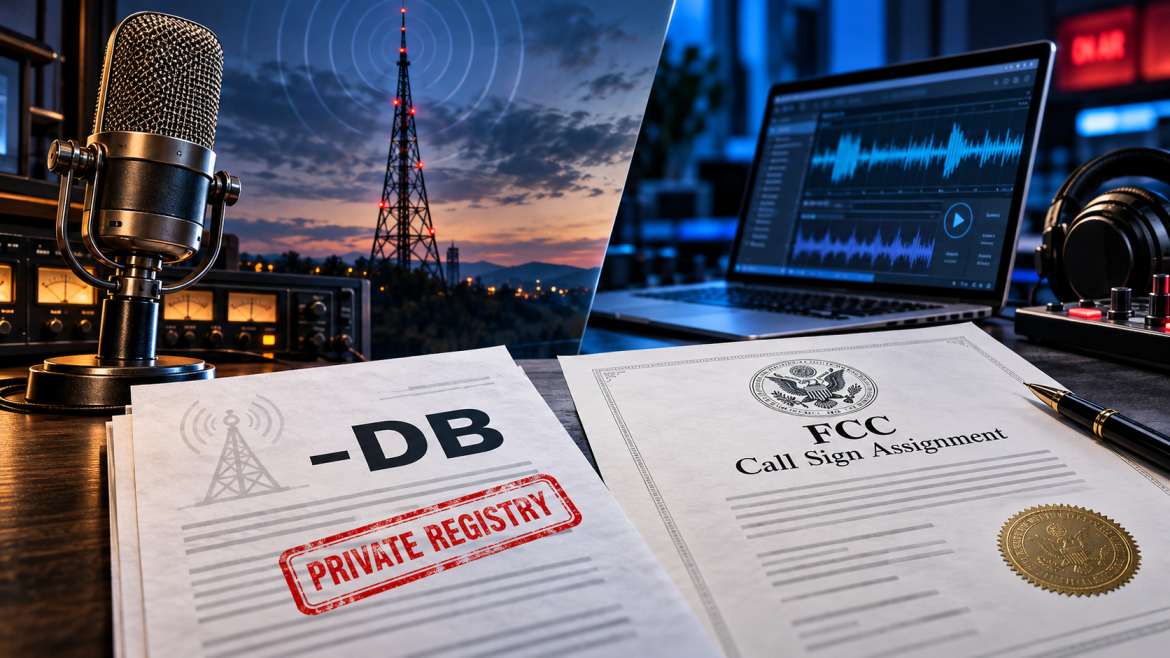
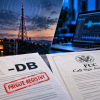
Today, online broadcasters can pay private organizations to register identifiers ending in “-DB,” supposedly standing for “Digital Broadcast.”
The presentation looks familiar. Four letters, a suffix, a registration process, and the suggestion that your little internet station has joined the ranks of traditional broadcasters.
There’s just one problem.
The FCC does not recognize “-DB” as an official broadcast call-sign suffix.
And that raises a legitimate question for internet radio operators: What exactly are you buying?
The FCC, not a private registry, assigns official broadcast call signs
Let’s begin with the actual regulations.
The federal regulations establish the procedures governing those assignments.
Depending on the broadcast service, recognized designations include -FM, -LP, -TV, -DT, -LD, and -CD.
What you will not find is a general FCC broadcast classification ending in “-DB.”
That distinction matters because a recognizable identifier is not necessarily a federally assigned call sign.
There is nothing inherently wrong with an internet station incorporating letters into its branding. But an operator cannot purchase federal broadcasting authority from a private association.
An official call sign also should not be confused with a broadcast license. The two serve different purposes.
A license authorizes operation of a regulated broadcast facility. A call sign identifies that facility.
Buying a private identifier accomplishes neither.
The Digital Broadcast Alliance’s own website explains the difference
One of the organizations offering these identifiers is the Digital Broadcast Alliance, or DBA, which describes itself as the successor to the National Association of Digital Broadcasters.
According to its website, the organization was founded in 2009 and provides education, support, advocacy, and registration services for internet-based broadcasters.
Its registration system uses what it calls Digital Broadcast Uniform Callsigns, or DBUCs, and Digital Radio Uniform Identifiers, or DRuIDs.
At first glance, that terminology sounds remarkably official.
But here’s where things become interesting.
On the organization’s own frequently asked questions page, it addresses whether a “-DB” call sign constitutes a broadcasting license.
Its answer is one word:
“No.”
The organization describes its identifiers as a standardized cataloging system intended to make internet stations easier to identify and locate.
It also acknowledges that registration is not legally required.
That’s a significant admission.
The service is a private naming and cataloging arrangement. It isn’t a federal call-sign assignment process.
The DBA claims rights associated with its “-DB” service mark, which may matter under applicable trademark and contractual rules. But private trademark rights are not the same as federal broadcast authority.
REC Networks delivers an even clearer explanation
For broadcasters looking for an independent industry perspective, REC Networks has addressed this exact issue.
REC Networks specializes in broadcast regulatory information and low-power FM matters.
In a January 25, 2024, explanation regarding internet radio stations that also operate FCC-licensed low-power FM facilities, REC Networks makes the critical distinction: an internet station’s privately registered “-DB” identifier does not replace its FCC-assigned call sign.
If an LPFM broadcaster wants to announce both identifiers, REC Networks recommends giving the FCC-required legal identification first, followed by separate language identifying the internet service.
For example, a terrestrial station legally assigned WAAA-LP cannot simply combine its official LPFM identity and privately registered “-DB” identity into one FCC legal identification.
The station must properly distinguish between the two.
That’s because a private internet radio registration has no power to modify the station’s FCC licensing obligations.
No amount of money paid to a private registry changes that.
A $28 membership does not buy federal recognition
The Digital Broadcast Alliance advertises a two-year station membership for $28 on its membership page.
For that fee, the organization describes benefits including a station identifier, member page, station listing, and access to advice and resources.
Those may have value to individual operators.
But the question isn’t simply whether $28 is affordable.
It’s whether broadcasters understand what the payment actually provides.
A private association can establish a directory, organize member stations, develop its own naming conventions, and charge for those services.
There’s nothing inherently improper about that business model.
However, the resulting identifier does not become federally recognized merely because its format resembles the call letters traditionally used in American broadcasting.
And if the objective is simply to give your station a memorable identity, internet broadcasters already have other ways to accomplish that.
The branding problem nobody wants to discuss
This is where the issue goes beyond federal regulations and becomes a question of professional broadcasting practices.
In terrestrial broadcasting, call letters have a regulatory function. For decades, they have also carried substantial brand recognition.
Listeners know stations by names such as WABC, WLS, or KROQ.
But those identities developed through decades of programming, audience relationships, local relevance, and marketing.
The letters themselves didn’t create that value.
The programming did.
Internet broadcasters sometimes make the mistake of believing that adopting traditional radio terminology automatically makes their operation more legitimate.
It doesn’t.
A station doesn’t become more professional because its website displays something resembling federally assigned call letters.
It becomes professional through consistent programming, reliable technical operations, effective audience development, and responsible business practices.
You can purchase an identifier.
You cannot purchase credibility.
That has to be earned.
What about trademark protection?
There’s another issue that internet station owners should understand before registering a “-DB” identifier.
The DBA itself acknowledges that an internet broadcaster could register an identifier resembling an existing FCC-assigned call sign, even when that terrestrial station operates under different ownership.
The organization also cautions that such use could create trademark disputes.
That’s important because a private registration is not a substitute for trademark clearance.
Simply obtaining something like WXYZ-DB does not automatically give you superior rights over an existing station using WXYZ.
Nor does an FCC call-sign assignment, by itself, settle every private trademark dispute.
Depending on the circumstances, trademark protection may arise from federal registration or established commercial use.
This is another reason station owners should perform a proper brand search before investing in logos, websites, imaging, and advertising.
The last thing an independent broadcaster needs is to build an entire station identity around letters that create a legal conflict.
What internet radio operators should actually invest in
Having worked in terrestrial broadcasting and now operating an independent digital radio station, I’ve seen how easily some internet broadcasters become distracted by the appearance of professionalism instead of the substance.
And this is where I think the industry needs a reality check.
If you’re launching an internet radio operation, your priorities should be straightforward.
Brand identity: Develop a memorable, distinctive name that listeners can recognize across platforms.
Programming: Build a format with a coherent music strategy, proper rotations, consistent clocks, and a recognizable station sound.
Technical reliability: Invest in automation, audio processing, stream stability, and dependable hosting.
Music licensing: Understand your streaming royalty obligations and ensure your operation has appropriate coverage.
Distribution: Make your programming accessible through your website, streaming directories, apps, connected speakers, and other relevant platforms.
Audience development: Focus on attracting listeners, keeping them engaged, and converting occasional tune-ins into regular listening habits.
These are the elements that determine whether an internet radio station becomes a viable broadcasting business.
A privately issued set of call letters isn’t going to fix poor programming, unreliable streaming, bad audio, or a nonexistent promotional strategy.
Does that make the Digital Broadcast Alliance a scam?
This deserves a precise answer.
The fact that “-DB” identifiers are not federally recognized does not, by itself, establish that the Digital Broadcast Alliance is operating a fraudulent business.
The organization openly states that its identifiers are not broadcast licenses and explains that its registration system is private.
It also advertises membership benefits beyond the identifiers themselves.
Those disclosures matter.
What broadcasters should challenge is any suggestion, whether from a reseller, promoter, station operator, or third party, that a privately registered “-DB” identifier carries the same regulatory authority as an FCC-issued call sign.
It doesn’t.
Whether a particular sale constitutes deceptive marketing would depend on the actual representations made, the transaction, and applicable law.
But the underlying industry question remains completely legitimate.
Why are internet station owners paying for an unofficial call-sign designation when they may not need one at all?
If a broadcaster finds the directory services and membership benefits useful, that’s a business decision.
If the broadcaster believes the purchase provides federal recognition, that belief is mistaken.
And if someone is using an unofficial designation to imply that their station has special FCC standing, the claim deserves scrutiny.
The PD Breakdown: Stop confusing appearances with authority
Here’s where I come down on the issue.
Internet radio has spent years fighting for credibility.
The industry has matured enormously, with legitimate independent operators building professionally programmed stations that reach audiences well beyond the limitations of traditional terrestrial signals.
That’s worth celebrating.
But part of becoming a serious industry is learning to distinguish between the things that actually matter and those that merely look impressive on paper.
You don’t need to imitate every tradition of terrestrial broadcasting to become a successful digital broadcaster.
And you certainly don’t need to purchase a privately assigned “-DB” identifier to prove you’re legitimate.
The FCC hasn’t given these private identifiers the standing of federally assigned broadcast call signs.
The Digital Broadcast Alliance’s own website confirms that its system is a private registration and cataloging service.
REC Networks independently explains why those identifiers cannot replace FCC-issued call signs.
The facts are not particularly complicated.
The FCC assigns official broadcast call signs. Private organizations assign private identifiers. They’re not interchangeable.
For internet broadcasters, the decision to purchase a private identifier should come down to whether its actual services provide measurable value.
Not whether the letters make the station look more official.
Because at the end of the day, listeners don’t care about certificates hanging on the studio wall.
They care about what comes out of the speakers.
And in radio, that’s where credibility has always been earned.
Editorial note: The article deliberately avoids labeling the Digital Broadcast Alliance a criminal enterprise or making unsupported fraud allegations. Its own published disclosures are more useful evidence than an accusation that cannot be substantiated. That approach makes the piece stronger and more defensible for publication under the Deep South Broadcasting name.
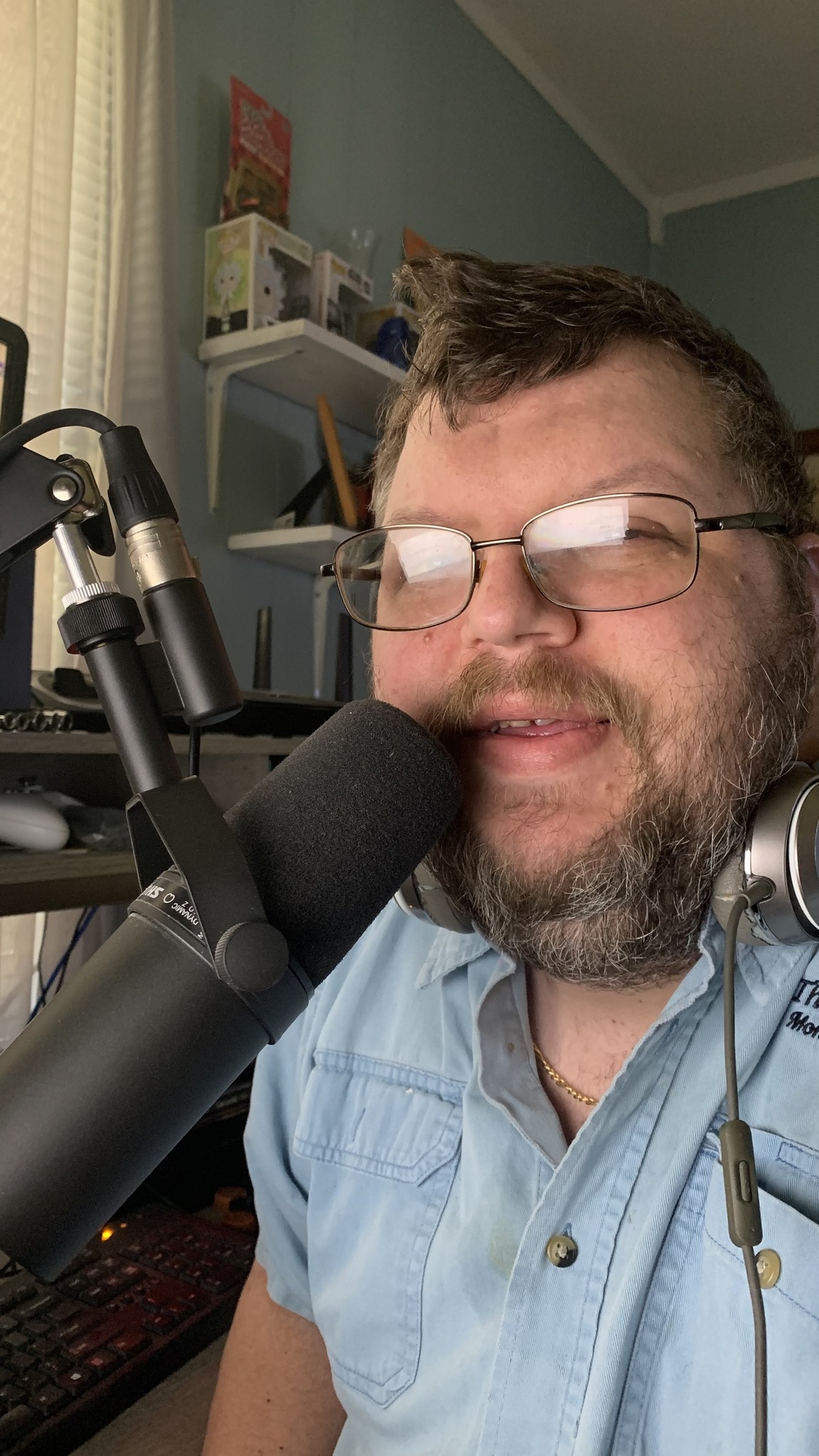
Jason Davenport is a seasoned media professional with over two decades of experience in the fields of broadcasting, audio/video production, and media consulting. Based in Montgomery, Alabama, Jason is the owner of Deep South Media, where he specializes in providing innovative solutions for clients, including podcasting, blogging, web design, and social media management.
Similar posts

-

Throwback Jam
Presented by Ryan Taylor
Take a trip down memory lane with the best throwback pop songs of all time. From the classics to the anthems of your youth, Throwback Jam revives the tracks that still make you sing, dance, and reminisce.
close ON AIR
Throwback Jam
Presented by Ryan Taylor
Take a trip down memory lane with the best throwback pop songs of all time. From the classics to the anthems of your youth, Throwback Jam revives the tracks that still make you sing, dance, and reminisce.
closeHOT NEWS
Top popular

Stainless Steel Juicer – Making Juicing Fun And Easy

10 Health Tips for 40 years old parents

Can the Crestron Home Automation System Be Integrated With Sonos?

We Need To Elect Public Leaders, Willing To DIRECT Us, Properly!
Reimagining Rock Radio: Why XLoungeRadio.com Isn’t Just a Station — It’s a Statement
Post comments (0)